
Metechi
Designing the Foundation of a Financial Marketplace
Project info
Deliverables
Strategy, Design Sprint, UX/UI, Product Design
Category
Fintech
Results
The platform supported over $1B in active assets, enabled a $5M raise, and established the clarity and structure needed for long-term growth.
Timeline
16 weeks
The Overview
Metechi emerged with a bold aspiration: to create a modern, secure marketplace where banks, brokers, and institutional investors could buy, sell, and syndicate commercial real-estate loans with clarity and confidence.
In an industry defined by legacy systems, complex regulations, and slow-moving workflows, the founders saw an opportunity to rethink how capital should move. They envisioned a platform built on trust, transparency, and efficiency — a digital environment suited for high-stakes financial relationships.
Our team was brought in to shape the very first version of this product. The mandate was clear:
Design an MVP capable of proving the concept, handling real financial activity, and establishing the foundation for future scale.
Within months, Metechi evolved from an early idea into a functioning platform that would go on to support more than $1B in live assets and help fuel a $5M fundraising round.
This is how that foundation was built.




The process
The Challenge — Regulation, Complexity, and No Margin for Error
Financial marketplaces come with significant constraints. Every interaction touches compliance, data security, auditability, and institutional reputation. A single UX misstep can undermine trust.
The challenge was multifaceted:
Multiple user groups with different priorities and risk tolerances
Highly sensitive data requiring the strictest access controls
Workflows filled with legal checkpoints and documentation trails
Complex business logic that needed to be expressed through intuitive user flows
Security wasn’t merely a feature — it was the emotional core of the product.
Users needed to feel, at every step, that the platform was safe, clear, and reliable.
To ensure accuracy and alignment, we broke the product into small, actionable segments, each with its own prototype, review loop, and approval cycle.
Only when a segment was fully validated did we move on to the next.
This approach kept the team focused, controlled complexity, and allowed us to build momentum while navigating a deeply regulated environment.
Discovery — Learning How Capital Actually Moves
Before designing, we immersed ourselves in the operational realities of loan origination, syndication, and acquisition. We mapped the journeys of:
Bank originators
CRE investors
Brokers
Loan buyers and sellers
Each group had its own friction points.
Across all conversations, one theme repeated itself:
The process was fragmented, opaque, and overloaded with paperwork.
We studied existing workflows, identified bottlenecks, and clarified how decision-making moved from person to person — and from institution to institution.
This discovery work became the backbone of our UX strategy. If we could unify these fragmented steps into a coherent digital experience, the platform would unlock real value for all participants.
The Breakthrough — Designing Trust Through Structure
The turning point came when we reframed the product not as a marketplace, but as a structured, sequential workflow system.
Instead of showing everything everywhere, we designed the platform around:
Clear access control
Role-based visibility
Document trails
Approval logic
Transparent status updates
Secure communication channels
Every screen reinforced trust through clarity:
Who sees what, when, and why was never ambiguous.
This structure allowed complex processes — posting deals, submitting bids, reviewing documentation, approving participation — to unfold predictably and securely.
It transformed a high-friction process into a guided, auditable flow.
Product Identity — A System Built for Function, Precision, and Scale
Information Architecture
We created a modular architecture that separated core marketplace activities:
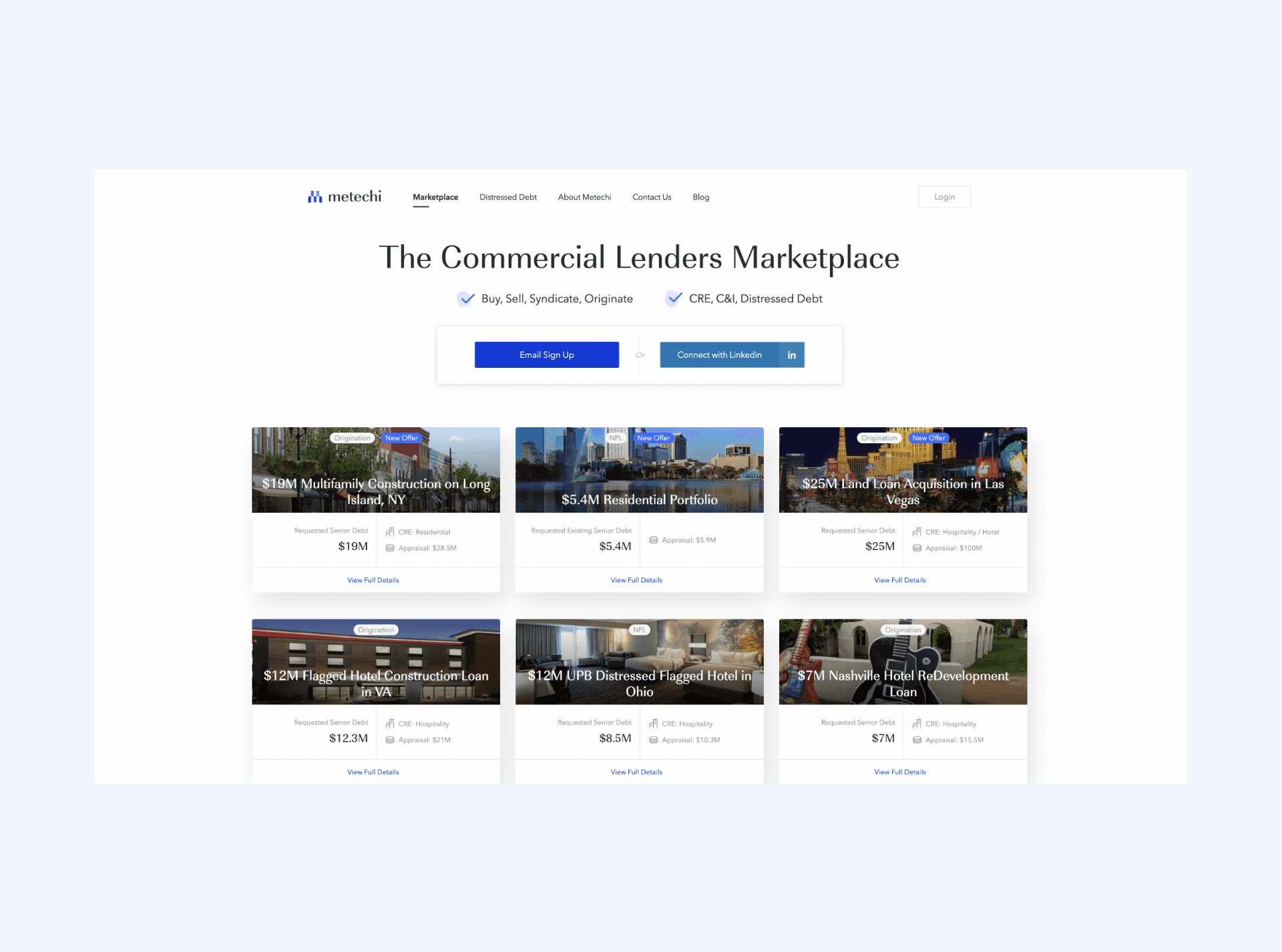
Loan posting
Deal review
Document exchange
Bidding
Approval workflows
Transaction tracking
This ensured that as the product grew, new features could be added without destabilizing the foundation.
User Flows & Wireframes
We developed extensive user flows illustrating every step of the loan lifecycle.
These flows became critical tools for aligning business logic with product behavior.
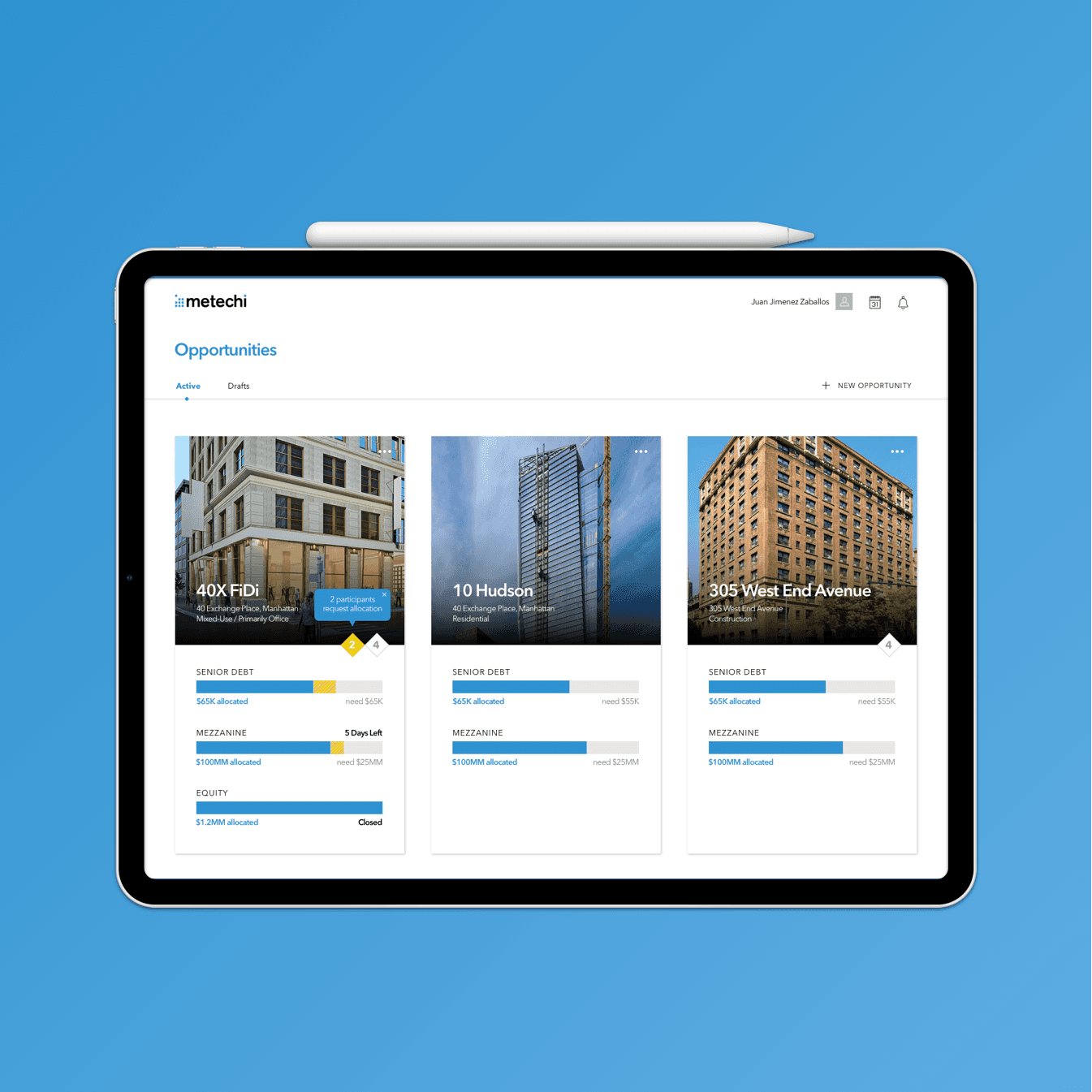
Dashboard Design
We built a dashboard where each user type — bankers, brokers, investors — could see only what was relevant to their responsibilities.
No noise. No confusion. Only actionable information.
Marketplace Interaction Model
The matching, bidding, and deal-tracking systems were redesigned to reflect how financial institutions actually operate, not how consumer marketplaces behave.
We didn’t aim for novelty — we aimed for accuracy, reliability, and institutional usability.
Results — A Platform Ready for the Real World
Metechi launched its MVP within six months, and the impact was immediate.
After launch:
The platform supported over $1B in active assets
The clarity and structure of the system helped the company secure $5M in fundraising
Banks, brokers, and investors were able to use the platform confidently from day one
The UX and product structure set the groundwork for the company’s future growth and evolution
The team later shared this feedback:
“It was a pleasure working with Stanley on the Metechi MVP. He helped us clarify business logic, refine user flows, and elevate usability across the platform. He was fast with prototypes, quick with solutions, and seamless to collaborate with — even remotely.”
Legacy — The Foundation for What Came Next
The MVP became more than a prototype.
It became the operational backbone of Metechi’s next chapter.
The clarity of the user flows, the structure of the workflows, and the emphasis on security allowed the company to evolve, scale, and eventually transition into its next iteration.
The work demonstrated that:
When a complex system is designed with precision and intention, transformation becomes possible.
Metechi’s early product didn’t just validate an idea — it reshaped what a digital loan marketplace could be.