Jan 26, 2026
How Brands Can Start Thinking Multi Sensory
Why Multi-Sensory Branding Matters Now
I have spent much of my career designing brands from the inside. Sitting in rooms where decisions are made about colors, logos, layouts, and campaigns. Over time, a quiet contradiction became impossible to ignore. The brands that performed best were rarely the ones with the most refined visuals. They were the ones that knew how to create a feeling and sustain it consistently.
Human memory does not work the way most brand systems are built. Studies in neuroscience and behavioral psychology show that emotion plays a central role in decision making and recall, and that emotion is largely driven by non visual sensory input. Research from the Rockefeller Foundation suggests that people remember only about 20 percent of what they see, but more than 35 percent of what they smell and a far greater portion of what they experience emotionally. Retail and hospitality studies consistently show that intentional sound and scent design can increase dwell time by 30 to 100 percent and improve perceived quality without changing the product itself.
Yet most brands still stop at the visual layer.
This is why so many companies struggle with sameness. Their brand looks polished, but it does not stay with you. It performs well on a screen, but disappears the moment you step away. When a brand has no sound, no texture, no rhythm, no atmosphere, it becomes a moment instead of a memory.
Multi sensory branding is not about adding more stimulation. It is about designing coherence across the senses so that every interaction reinforces the same emotional truth.
What the Data Is Telling Us
The data around sensory experience is clear and increasingly hard to ignore.
Brands that activate multiple senses create significantly stronger emotional bonds, often measured at increases of 50 to 70 percent compared to single-sense experiences. Studies in retail environments show that well-designed soundscapes can increase time spent in a space by up to 40 percent, while scent alignment has been linked to higher perceived value and increased willingness to pay. In product design, tactile quality is one of the strongest predictors of perceived trust and durability, even before use.
None of this is theoretical. These effects show up in conversion, retention, and long-term brand equity.
How Brands Can Start Thinking Multi Sensory Today
You do not need a large budget or a full rebrand to begin. What you need is intention.
Start with awareness. Pay attention to what your brand already communicates through the senses. Listen to the sounds that accompany your experience, whether that is music, notifications, ambient noise, or silence. Notice the materials, textures, and finishes people touch. Observe the pacing of interactions. Does your brand feel rushed or calm. Heavy or light. Cold or warm.
Next, define the emotional outcome before the execution. Instead of asking how something should look, ask how someone should feel during and after the interaction. Grounded. Energized. Reassured. Curious. This emotional clarity should guide sensory decisions.
Experiment in small, reversible ways. Change the sound environment in a space for a week and observe behavior. Adjust materials in packaging or physical touchpoints and listen to feedback. Introduce intentional pauses and breathing room into digital flows. These micro shifts often reveal more than large conceptual exercises.
Design for consistency rather than novelty. Multi sensory branding works when the same emotional signal is reinforced again and again. Repetition builds trust. Restraint builds presence.
Finally, document what works. Treat sensory decisions as part of your brand system, not as decoration. Write them down. Share them internally. Make them teachable.
A Way Forward
The brands that will matter in the next decade will not be the ones shouting the loudest or chasing the latest aesthetic. They will be the ones that understand atmosphere. Brands that know how to feel human in a world that increasingly feels automated.
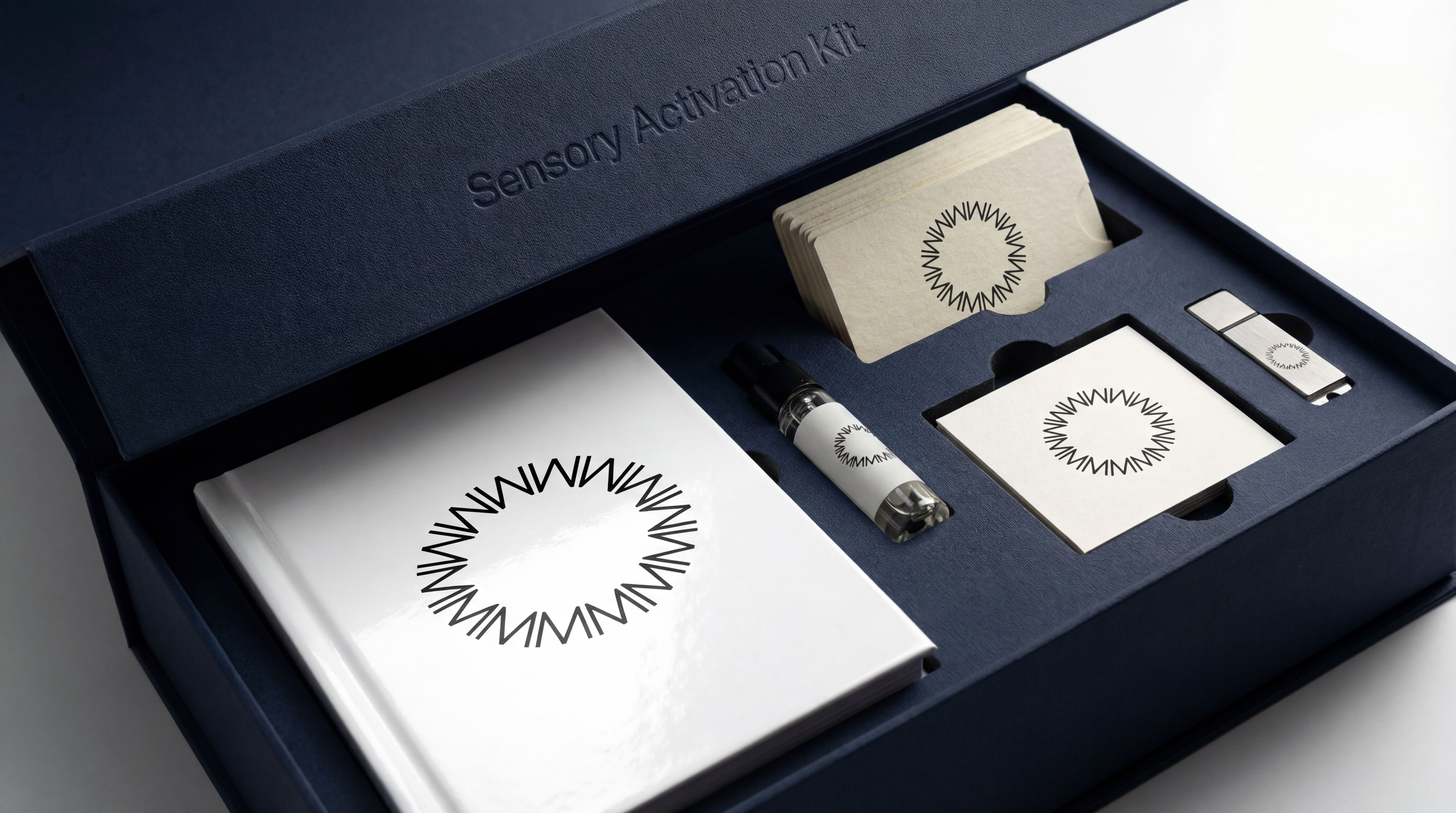
For teams who are already thinking in multi sensory layers and want a structured way to explore and prototype their brand world, we offer a Multi Sensory Activation Kit. It is designed to help teams translate intuition into tangible insight and move from isolated ideas to a cohesive sensory foundation.
But whether you use a tool or not, the work begins the same way. Stop designing only for the eyes. Start designing for the human nervous system. That is where memory, trust, and meaning are actually built.
Continue Reading
Explore ideas, trends, and behind-the-scenes stories from our studio.